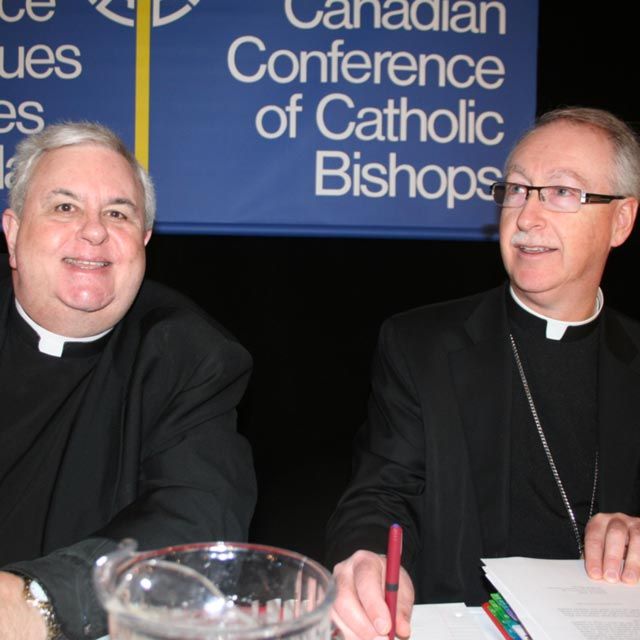
Tuesday, 27 November 2012

Letter to Archbishop Smith by Herbert J. O’Hearn


Archbishop Smith
President of the Canadian Conference of Catholic Bishops
2500 Don Reid Dr.
Ottawa, ON
K1H 2J2

Dear Archbishop Smith:

I am writing as a concerned Catholic in follow-up to a recent article in the Globe and Mail in which International Development Minister Julian Fantino announced the Government’s intention to see Canada’s international development agency align itself more closely with the private sector and work more explicitly to promote Canada’s economic interests abroad.

In hindsight, it is difficult to argue that Development and Peace’s call for a public discussion about the direction of Canada’s foreign aid program this past fall was anything but prophetic. One can only assume that this announcement comes as a surprise to the Conference in that it had explicitly informed Development and Peace, and through it Canadian Catholics, that they would be ill-advised to object to the commercialization of Canada’s foreign aid program, as this might upset delicate negotiations between the Conference and the Harper government. It would seem that these discussions were either unsuccessful, or that they had little to do with the interests of the world’s poor.

In light of the Government’s now publicly announced intention to turn its back on the world’s poor, unless our aid money can do double duty by helping Canada’s business community, I wonder if the Conference has seen fit to amend its position? Is the Conference still asking Canadian Catholics to stand idly by while the declared objective of Canada’s foreign aid program moves from poverty eradication to business promotion? When did “You scratch my back and I’ll scratch yours” become one of the beatitudes?

I know that as a Canadian taxpayer I am called to voice my objection to any such perversion of Canada’s foreign aid program. However, I am not entirely certain that I enjoy this same privilege as a Catholic. Were I to write to the Government as a concerned Catholic would I be violating the unity of the Church? If I were to be joined by others in my parish are we able to declare our action an expression of our Catholic faith? Were an entire Diocese, or dare say a major Catholic organization now to make a similar appeal to keep Canada’s assistance effort focused on the poor, would it be a violation of the CCCB’s instruction?

As a Catholic activist, I must ask if we as Catholics can expect some clarification from the Conference as to whether or not we as Catholics are called to defend the Gospel values of sharing and solidarity in this case, or whether some sort of exception needs to be made? Are we able to advocate within the Church for a greater level of democratic participation in the design of Canada’s foreign policy, or is merely calling for a public discussion somehow partisan? More importantly, can we anticipate any leadership from the CCCB on the substance of the issues involved? Are Canada’s bishops prepared to comment on the Government’s intention to sacrifice the fundamental precepts of one of the world’s more progressive foreign aid programs on the altar of “Canada’s Economic Action Plan”.

As I understand it, your earlier intervention was premised on preserving Church unity, surely we as Catholics are not only called to unity but entitled to be united under our Bishops leadership in defending the interests of the poor and oppressed.

Thanking you for it in advance for your reply, I remain

Yours in Christ

Herbert J. O’Hearn


Monday, 26 November 2012

D&P A Crisis Between the Laity and the Bishops

http://www.ledevoir.com/societe/ethique-et-religion/364881/l-agonie-de-l-organisme-developpement-et-paix-une-crise-entre-les-laics-et-les-eveques-catholiques


L’agonie de l'organisme Développement et Paix - Une crise entre les laïcs et les évêques catholiques

Jean-Claude Leclerc   26 novembre 2012  Éthique et religion
<div>
 Alors que les évêques se sont immiscés dans le débat autour de la motion controversée du conservateur pro-vie Stephen Woodworth (ci-dessus), ils ont gardé le silence lorsque le gouvernement a coupé dans l’aide au développement ou en a modifié les règles.</div>
Photo : La Presse canadienne (photo) Adrian Wyld
Alors que les évêques se sont immiscés dans le débat autour de la motion controversée du conservateur pro-vie Stephen Woodworth (ci-dessus), ils ont gardé le silence lorsque le gouvernement a coupé dans l’aide au développement ou en a modifié les règles.
Développement et Paix (D & P) est à l’agonie. Sous la pression d’évêques pro-vie et faute de subventions fédérales suffisantes, le gros du personnel est parti, pour laisser plutôt aux projets d’aide en pays pauvres les fonds encore disponibles. La dernière campagne de souscription, révisée par la haute hiérarchie, en aura marqué l’implosion, alors que les membres laïques voulaient alors interpeller la politique du cabinet Harper en faveur des minières canadiennes à l’étranger.
Les « modifications » à cette campagne ont été faites à l’initiative de la Conférence des évêques catholiques du Canada (CECC). Ces autorités ont voulu rassurer les membres de l’organisation. La raison de ces changements était « simple », leur ont-elles déclaré. Lors d’une réunion entre la direction de la CECC et celle de D & P, « une préoccupation a été soulevée selon laquelle le matériel présenté pourrait être une source de division entre les évêques, les prêtres, les paroissiens et les bienfaiteurs ».
 
« L’absence d’unité risque de compromettre notre témoignage chrétien de justice et de charité, ajoutaient-ils. Ces préoccupations ont été prises très au sérieux. Développement et Paix a décidé de réviser le matériel de sa campagne. » Toutefois, cette initiative aura surpris des évêques proches de l’organisation, mais surtout le personnel et des membres de D & P qui y « militent depuis 20 à 30 ans ».
 
Ainsi, à Valleyfield, le conseil diocésain de D & P a publié un communiqué dénonçant les « modifications » et l’intervention de la CECC. « Nous ne reconnaissons plus notre organisme », écrivent-ils. « Cet organisme laïc est pris en otage par un petit nombre d’évêques liés au pouvoir politique et à la droite religieuse. » Ils estiment ne plus pouvoir « garder silence et être complices du sabordage de Développement et Paix » et de « sa mission prophétique ».
 
Cette mission doit être une mission, disent-ils, « de transformation sociale et de signe d’espérance pour les femmes et les hommes les plus vulnérables ». Toujours solidaires de D & P, ils croient que l’organisme peut rester « un agent de dénonciation des structures de l’appauvrissement des pays du sud et une conscience sociale pour les gens d’ici ». Entre-temps la déchirure semble s’agrandir au sein de l’Église catholique.
 
Ainsi, au moment où les Communes allaient débattre de la motion d’un conservateur pro-vie, les évêques invitaient tous les députés à « prendre en compte le caractère sacré de l’enfant à naître et de chaque vie humaine ». Ils encourageaient les catholiques du pays à prier pour que les parlementaires aient « la sagesse et le courage » de promouvoir le bien commun, « qui se fonde sur le respect de la dignité humaine de tous et de chacun ». Mais, auront noté des gens de D & P, ils restent cois sur le détournement de l’aide fédérale jusqu’ici réservée aux populations du tiers-monde.
 
Si de rares évêques de l’Ouest canadien s’inquiétaient en 2009 de l’exploitation des sables bitumineux, la CECC, plus récemment, n’est pas intervenue quant aux coupures de fonds de l’ACDI à des ONG socialement « engagées », dont Développement et Paix. Les évêques catholiques ne se sont pas non plus prononcés sur la politique fédérale confiant aux minières d’ici l’aide canadienne aux pays d’Afrique ou d’Amérique du Sud.
 
Enjeux moraux
D’importants enjeux d’ordre moral sont pourtant en cause. D’abord, les minières, les canadiennes comme les autres, excellent à extraire les ressources qui les attirent. Elles réussissent en général à bien s’entendre avec les régimes en place, dont plusieurs sont faibles, corrompus ou autoritaires. Elles sont en plus réputées pour fort peu tenir compte des populations locales. Et leur compétence en développement socio-économique n’est pas évidente.
 
Ensuite, l’expérience enseigne que les petites et moyennes entreprises locales contribuent au développement des populations et de leurs conditions de vie davantage que les multinationales dont les choix sont dictés, non par les besoins de ces gens, mais par les exigences des actionnaires et les fluctuations des marchés. En misant plutôt sur les multinationales canadiennes, fussent-elles liées à des ONG d’ici, le cabinet Harper ne fait-il pas œuvre de favoritisme électoral à même les fonds fédéraux ?
Enfin, qu’il s’agisse d’entreprises à but économique ou d’organisations philanthropiques, l’aide internationale s’est souvent révélée être un échec dans les pays privés de gouvernement compétent et honnête. Par contre, les millions de l’aide au « développement » auront attiré les exploiteurs étrangers et incité les profiteurs de tout acabit à se ruer sur le gouvernement du pays. Comment mieux étouffer tout effort de progrès social et démocratique ?
 
L’agonie de Développement et Paix aura mis en relief des enjeux éthiques de cette nature, dans le milieu de la coopération au pays, mais aussi parmi les organisations catholiques. Que de tels enjeux aient cependant échappé à des évêques qui prétendent, à l’occasion, donner en matière de justice économique et sociale un éclairage moral aux autorités civiles et aux « gens de bonne volonté », confirme, s’il en était besoin, un problème de leadership au sein de l’Église catholique.
 
Car l’échec des grandes compagnies est patent dans les régions excentriques ou autochtones du Canada, une situation que tout évêque est à même de constater. De même, ailleurs sur la planète, les injustices économiques et sociales affligent les pauvres, notamment les femmes et les enfants, ce dont les missionnaires canadiens sont des témoins éloquents. Dès lors, le rôle ambigu d’un épiscopat devenu plus proche d’une mouvance sectaire que de ses propres fidèles risque d’en blesser plus d’un.
 
Jean-Claude Leclerc enseigne le journalisme à l’Université de Montréal.

Haut de la page

Development and Peace Spat a Many Layered Story


Development and Peace Spat a many layered story

Sunday, 25 November 2012

LETTRE DES SOEURS OBLATES FRANCISCAINES DE ST-JOSEPH – Sr Pierrette Bertrand


M. Michael Casey
Directeur de Développement et Paix
Monsieur Casey,
En tant que communauté religieuse partenaire de Développement et Paix (D&P) depuis sa fondation, nous avons suivi de près le débat qui concerne les orientations de cet organisme, en particulier les choix qui ont été faits à propos de la campagne d’automne 2012.
Le fondement de notre soutien à certains organismes de coopération internationale se situe dans le choix qu’ils font d’allier un soutien financier à des projets de développement et de justice sociale et d’entreprendre un travail d’éducation sur les causes des injustices à la base de la pauvreté et du mal-développement.
Par travail d’éducation, nous entendons la sensibilisation et l’information sur des mesures prises par des institutions privées et publiques qui ont un impact sur l’accroissement ou le maintien de situations d’injustice. Pour nous, pour être complet, ce travail d’éducation doit s’accompagner de moyens d’actions appropriés pour transformer la situation vers plus de justice et d’équité. Il n’y a pas de véritable travail de conscientisation à une pleine citoyenneté, si celui-ci ne facilite pas l’exercice même de cette citoyenneté.
Voilà pourquoi nous ajoutons notre voix à celle de toutes les personnes qui remettent en question le choix de la direction de D&P de mettre au rancart le matériel prévu pour la campagne d’automne 2012 suite à des pressions de certains évêques qui, semble-t-il,  jugeaient le matériel  « trop politique ».  Une carte postale adressée à M. Harper exprimant notre désaccord avec les coupures et les nouvelles orientations de la politique d’aide internationale du Canada serait à l’origine de cette dissension.
Nous avons pris connaissance de votre lettre du 29 octobre 2012 adressée aux membres individuels de D&P. Ce qui est mis en évidence, c’est la nostalgie des Noëls d’antan ou des Noëls familiaux dans des pays en développement. Le tout accompagné d’une étoile « pour décorer notre sapin » et qui « rappelle l’étoile de Bethléem qui guida les Rois Mages vers l’enfant Jésus ».
Sauf une invitation à renouveler notre don, aucun geste de prise de parole n’est proposé à propos des choix de notre gouvernement. Sans cohérence de notre part à ces deux niveaux, nous risquons de donner carte blanche à notre gouvernement pour saboter par ses politiques tous nos efforts de solidarité internationale.
Qu’est-ce qui distinguera cette étoile des autres étoiles de Wall Mart dans les sapins? Vous nous pardonnerez d’avoir perçu dans cette symbolique un caractère superficiel et infantilisant. Ce dont D&P ne nous avait pas habitués.
Nous ne sommes pas sûres que le recours au sentimentalisme et à la nostalgie des Noëls d’antan soit le meilleur moyen pour faire en sorte « que la lumière soit là pour tous à Noël ». Nous sommes de ces gens qui souhaitons ardemment « que la lumière soit là pour tous »…à tous les jours de l’année! Et cela exige un travail d’analyse et des gestes qui aient un caractère politique.
Pourtant, la lucidité ne manque pas à D&P. Sur la première page d’un « document de discussion », le constat est indiqué en caractère gras et se veut clair : « PLUS QUE JAMAIS, LE MONDE A BESOIN DE NOTRE SOLIDARITÉ ».
Sur la page 3, en caractères encore plus grands, la reconnaissance des faits se fait péremptoire : « UNE AIDE INTERNATIONALE INADÉQUATE FACE AUX BESOINS DE L’HUMANITÉ ». Et D&P décrit très bien les politiques du gouvernement Harper quant à l’aide internationale.
Devant cet état de fait, nous vous faisons part des questions qui nous habitent :
Pourquoi le « document de discussion » vient-il après la décision de la direction de mettre au rancart le matériel de campagne d’automne 2012? Comment ne pas y voir une tentative de faire avaler la pilule après-coup sous des apparences d’ouverture démocratique et de transparence?
Pourquoi  le « document de discussion » n’inclut pas une proposition de moyens d’action? Ne serait-ce pas une façon de soumettre ceux-ci au discernement des membres afin qu’ils consolident vos choix et qu’ils se les approprient avec plus de détermination? Les discussions, limitées à elles-mêmes, n’ont jamais produit les changements escomptés.
Quelle est la portée d’un « document de discussion », si excellent soit-il au niveau de l’analyse des faits, si aucune stratégie n’est proposée pour favoriser cette discussion, pour en colliger toutes les données et pour orienter notre action en fonction des consensus établis?
Nous croyons que les populations du Sud constituent les principales victimes de la fracture actuelle à D&P. Est-il trop tard pour profiter de la crise afin d’organiser un débat démocratique avec tous les membres de Développement et Paix de sorte qu’ils aient la chance d’exprimer leurs idées sur les meilleurs moyens qu’ils identifient pour relever les défis du développement au XXI ème siècle?
Nous terminons par une demande précise. Comme les cartes postales de la campagne 2012 ont été imprimées grâce à l’argent collecté auprès des chrétiennes et des chrétiens sur la base de l’orientation historique de D&P, que ces cartes leur soient remises. Elles leur appartiennent. Libres à elles et à eux de les utiliser ou non.
Enfin, nous tenons à rappeler que notre solidarité avec les peuples en développement leur est acquise et est non négociable. Pour exprimer cette solidarité, nous pouvons compter sur plusieurs organismes crédibles. Comme organisme d’Église, nous souhaitons que D&P puisse continuer à être de ceux-là en assoyant sa crédibilité sur le jugement et le discernement du peuple de Dieu (Vatican II).C’est pour nous la condition de notre partenariat futur avec D&P.
En vous remerciant de l’attention portée à notre lettre.
Pierrette Bertrand, OFSJ
Supérieure générale
Cc : -   Mgr Richard Smith, président de la Conférence des évêques catholiques du Canada
-          Mgr Pierre-André Fournier, président de l’Assemblée des évêques du Québec
-          Mgr Jean Gagnon, président du Comité des Affaires sociales de l’Assemblée des évêques du Québec

D&P Knee Capped by Catholic Bishops

http://www.dennisgruending.ca/2012/11/development-and-peace-knee-capped-by-catholic-bishops/

Saturday, 17 November 2012


Abdicate or Resist?


Has Development and Peace lost its soul forever?  Are we to abdicate or to resist? In a spirit of revolt, some friends and long-time members have chosen to publicly withdraw their support. We can understand their action. Pillars of the organization have resigned as their situation became internally intolerable. Does that mean that the efforts at the grassroots level to organize resistanceare in vain? Since 1985 the Quebec Group for Contextual Theology (GTCQ) has reflected andacted on social and ecclesial issues in Quebec. As members of GTCQ and friends of Development and Peace we believe that the resistance deserves support and we put our energy into that option by a conviction that is both political and theological.    

The crisis Development and Peace has been going through for some time now was, at first, difficult to understand. This is particularly due to the lack of transparency on the part of its principal actors, namely the Canadian Conference of Catholic Bishops (CCCB) and the direction of the organization under pressure from the bishops. The most recent episode in this crisis is the cancellation of the essential element of the 2012 Fall campaign. As with all the campaigns of this sort since 1977, it had an awareness-building objective and proposed a concrete action that targeted the structural causes of a specific injustice. The intervention of the bishops revealed more clearly some of the driving characteristics of this endless crisis that led so many Catholics in this country as well as a large number of partners both here and abroad to despair.

More and more, it seems clear that the decisive factor lies in a power move perpetrated by a minority of bishops in the CCCB following attacks led by the LifeSiteNews agency against Development and Peace in 2009 and then again in 2011. We deplore the blackmail and theintimidation inspired by a retrograde concept of the Church and its mission that were imposed since then on decisions at Development and Peace. In this process there was an attempt to drag the whole CCCB in its wake. We no longer recognise the majority of our bishops in all this. The view that seems to us to underlie this twist is one that currently dominates the Vatican, that was also imposed on Caritas international and that will perhaps soon descend on CIDSE (International Cooperation for Development and Solidarity). Development and Peace is affiliatedto those two networks of catholic NGO’s.

Two destructive steps backward

The two main elements of this vision at stake in the fiasco that we are suffering are, in our opinion, the following: the prohibition imposed on Development and Peace of any questioning ofpolitical powers and also the de facto subjection to trusteeship by the clerical hierarchy of an organization that is entrusted to the responsibility of the laity by its official statutes.

In a recent communication, the President of the CCCB, Bishop R. Smith, and the President of the National Council of Development and Peace, Mr. R. Breau, affirmed jointly that their decision was based on the concern to preserve unity. In fact we are presented with two shifts that threaten the future and the unity of the Church far more than the Fall Campaign originally planned by Development and Peace. In fact, the campaign wanted simply to have the current orientations of the Harper government regarding public support for development examined in a parliamentary committee. What is there that is threatening in this anymore than in previous campaigns of awareness-building and of education organized by Development and Peace?

The first of these measures amounts to a dissociation of the hope announced by Jesus from any effective transformation of the social and political structures that generate injustice, exclusion and the violation of human rights. We thus return to a concept of the Church that places it outside orabove society, or even in collusion with the powers in place, rather than in solidarity with this world through which the Second Vatican Council considered the Church as “servant and poor,” reaching out to the Reign of God and committed to sustain prophetically the aspirations of people for justice and peace.

The second action is framed within the Roman wish to reaffirm the supremacy of the clerical institution in face of the suspected menace of an increasing independence of the laity. This hardening is in flagrant contradiction with the theology of the Church as people of God that wasreaffirmed by Vatican II. This cannot help but focus the Church on its own internal interests,demobilize the laity even as they are called to commitment, discourage efforts at renewal and creativity that are nevertheless so urgent, and marginalize even more an institution on its way to being discredited.

There is nothing coherent here with the declared objectives of the New Evangelization. Nor is there anything to provide new hope to many Catholics whose Church affiliation is shaken by all kinds of scandals and discouraging decisions. On the contrary, the recent intervention of the CCCB with regard to Development and Peace can only further weaken confidence in the pastoral authorities of the Church by creating confusion, deception and anger, even among some members of the clergy and even of the bishops. Is unity, in the name of which they have tried to justify this intervention, better served in this way?

An Appeal to the Diocesan Councils

In face of this betrayal of the mission of Development and Peace, resistance is called for.  But where could it come from?  In spite of the obstacles, there is already movement among the network of engaged members and the internal structures. In our opinion the key figure of this resistance must be found in the National Council of Development and Peace. It is urgent that its members reassess and reaffirm both their own autonomy in face of any abuse of power and their determination to respect the fundamental orientations of the organization, beginning with its mission of education and advocacy. This will require refusing to back down in face of any political or financial pressure.

In order to take up this challenge, it will no doubt be necessary to choose, as members of the Council and its executive, people who are convinced both of the urgency of this reassertion and also of pursuing the full mission of the Organization. We encourage the Diocesan Councils andlocal teams to support every effort in this directionThey will also need to stand up and exercisethe necessary pressure. We will be many, who will stand by your side.  


The Quebec Group of Contextual Theology

 Michel Beaudin, Céline Beaulieu, Guy Côté,
Lise Lebrun, Richard Renshaw

Wednesday, 14 November 2012

Letter to Michael Casey


Mr Michael Casey, Development and Peace 

Mr. Casey,

I got your circulation letter inviting us to "bring light to others for Christmas. Your proposal is one Development and Peace has maintained for decades: "Express our solidarity with our brothers and sisters in the South." Unfortunately, this looks like misrepresentation, because Development and Peace is no longer an organization partnering with women and men seeking to take control of their destiny.

You invite us to celebrate Christmas with courage, but it seems to me that the administrators of the organization have shown little courage in defending our organization before the pressures of a few thunderous conservative bishops. You have given up the bulk of the solidarity and Development and Peace is becoming, little by little, a charitable organization for those who think "Catholic". This is unacceptable and I am deeply distressed. I deplore the lack of transparency and courage that you have had in this conflict where you would have done well to be supporting your activist base rather than trying to save the furniture behind closed doors.

This is why I ask that you remove my name from your lists and do not solicit me again for donations or other collaborations. There are fortunately other places to "advance rights with conviction. In a historic moment where the Catholic Church is collapsing everywhere because of blind leadership, and bound by its Directors, Development and Peace is being carried away by the current fundamentalist that I cannot support.

Dismayed and disappointed,

Claude Lacaille, p.m.é. Trois-Rivières, Wed 14 November 2012 


Monday, 12 November 2012

Lettre aux présidents de la CECC et de l'AECQ


Mgr Richard W. Smith,
Président
Conférence des évêques catholiques du Canada (CECC)
2500 promenade Don Reid
Ottawa ON      K1H 2J2

Mgr Pierre-André Fournier,
Président
Assemblée des évêques catholiques du Québec (AECQ)
3331 rue Sherbrooke Est
Montréal QC      H1W 1C5


Monseigneur Smith, Monseigneur Fournier,

Nous, congrégations religieuses et groupes sociétaires de L’Entraide missionnaire (L’EMI), sommes impliqués dans la mission et la coopération internationale. À ce titre, nous sommes fortementpréoccupés par la crise sans précédent qui frappe l’organisme Développement et Paix (D&P). Nous en sommes de fidèles et fiers partenaires depuis ses débuts et son avenir nous inquiète au plus haut point.

Nous voulons vous exprimer aujourd’hui notre consternation face à l’annulation imposée par quelques évêques de la campagne d’éducation 2012 intitulée Agissons pour la justice et à sa révision ultérieure. Le silence de la direction de l’organisme face à une telle situation suscite notre stupéfaction. Depuis la fondation de l’organisme par l’épiscopat canadien dans la mouvance de Vatican II, les évêques ont toujours appuyé la mission prophétique de D&P, mission d’accompagnement solidaire de groupes et de mouvements des pays en développement qui travaillent à instaurer plus de justice et à promouvoir le respect des droits de la personne et des collectivités.

Depuis 2009, D&P fait l’objet d’attaques de la part de Life Site News et de pressions venant d’une portion conservatrice de l’Église. En février dernier, l’organisme a subi des coupures de 65 % de son financement par l’ACDI. Voici que maintenant la version originale de la campagne 2012 a été interdite parce que jugée « trop politique ». Pourquoi ce jugement cette année alors que les campagnes d’éducation ont eu, depuis 1978, une dimension politique? Serait-ce parce que cette campagne invitait les chrétiens et les chrétiennes d’ici à envoyer un message au premier ministre Harper, l’exhortant à repenser l’aide internationale canadienne qui n’a cessé de se transformer et de subir des coupures depuis quelques années?

 L’Évangile et l’enseignement social de l’Église conduisent à la lutte pour la justice sociale et à la défense des droits de la personne et exigent des démarches de conscientisation au sein des communautés d’ici et d’ailleurs. Cette conscientisation aboutit nécessairement en démocratie à prendre la parole et à poser des gestes citoyens auprès des autorités politiques qui ont le pouvoir de décision.

En conséquence, nous désirons vivement que D&P retrouve sa mission d’éducation et de plaidoyer pour la justice en invitant les chrétiens et les chrétiennes de chez-nous à poursuivre leur engagement dans la promotion concrète de la solidarité avec les partenaires du Sud soutenus par l’organisme.

Nous souhaitons que l’information circule et qu’un débat soit mené ouvertement avec les membres et les partenaires de l’organisme sur les enjeux de la présente crise à Développement et Paix. Nous invitons donc les membres de la CECC et de l’AECQ à favoriser le dialogue sur cette situation très préoccupante et à reconsidérer courageusement leur position face au travail d’éducation et de plaidoyer de D&P, entre autres face à sa campagne Agissons pour la justice.


En toute solidarité,


Les sociétaires réunis en assemblée générale

Par Suzanne Loiselle, directrice générale


Crise à Développement et Paix -Radio-Canada

Développement et Paix est l'une des plus importantes et anciennes agences de développement international au Canada. Elle a été fondée en 1967 par les évêques canadiens dans la foulée du concile Vatican II. Aujourd'hui, Développement et Paix...est pressurée par la montée de la droite à l'intérieur de l'Église catholique, ainsi qu'au Parlement à Ottawa. Elle vit donc une double crise qui pèse lourd...très lourd sur son avenir.


Letter to CCCB by Centre Justice et Foi


Montreal, October 30, 2012


His Excellency Richard Smith

President

Canadian Conference of Catholic Bishops (CCCB)
2500 Promenade Don Reid
Ottawa, (Ontario) k1H 2J2


Dear Bishop,


We have been dismayed in recent months by some of the decisions taken by the CCCB or by the silence that the CCCB has chosen in face of certain issues. Beyond that, the way some members of the leadership have acted disturbs us profoundly.

Ultimately, the principles of ecclesiology inspired by the Second Vatican Council seem to us to be imperilled by the current orientation of the CCCB. Concretely, this is happening through serious steps backward with regard to the rich tradition of the Church’s social teaching and by a political conservatism that has nothing to do with the Gospel. This new orientation also shows a loss of willingness within the Canadian episcopacy to exercise its responsibility to denounce the political choices that harm the dignity and rights of people. There is also a loss of will to bring about a more just society in solidarity -- whatever the political party in power. Finally, these actions reveal an official Church that is less and less interested in working together with organizations and social movements concerned about social justice.


And so we take note that no letter denouncing the many policies of the current government that attack human dignity and social justice has been made public for quite a long time, whether through your Justice and Peace Commission or through your executive. Nevertheless, there is no lack of issues! You have, instead, preferred to denounce the policies of foreign governments. While that is certainly justified, it puts the spotlight even more on your silence with regard to Canadian policies.


Even more, for some time now we note the repeated absence of the CCCB as signatory to important collective texts that were submitted to you (the appeal on climate change, the intervention by the Canadian Council of Churches on the major cuts among prison chaplains, and so on). Still, other Christian Churches or other religious leaders did participate.


This refusal to denounce the current political authorities has even led the executive of the CCCB to short-circuit the democratic process of Development and Peace, which is a beacon institution of the Catholic Church in Canada. By reorienting the Fall campaign and by unilaterally supressing the action (the postcards) proposed to faithful citizens by which they would challenge the federal government on the new and inacceptable orientations of Canadian international aid, you seem to put the preservation of your “good relations” with the Conservative government above any other consideration.


It is perhaps this attitude that explains your highly questionable choice to welcome Minister Jason Kenney to a closed-door meeting during the recent plenary assembly of the bishops. We have already sent you a letter expressing our disagreement with this decision and with the culture of secrecy that surrounds it. (We have not, by the way, received any recognition of that letter.) So it is that we continue to note that your positions with regard to Canadian policies on immigration do not always seem to be clear and transparent. During this same period, the Harper government continues to contribute to the weakening of the status of the most vulnerable immigrants. The most recent announcement in that list is the introduction of permanent temporary residence. This is a move that will have serious consequences. especially for the more disadvantaged women.


Finally, we have just learned, to our stupefaction, that the position of principal advisor on questions of social justice has been abolished. As you know, this principal advisor was precisely the person who allowed the bishops to be well-informed regarding issues related to justice, solidarity and peace. He represented the bishops at gatherings of other Churches and organizations with regard to dossiers that made it possible to keep the social commitment of the Church up to date and incarnated. He was also the person who undertook the research and writing necessary for your public positions on matters of a social character. The elimination of this position has been justified for economic considerations. It is nevertheless difficult for us to not see, in this decision, an additional proof of the regrettable orientations that we deplore in this letter.


Sincerely,


Élizabeth Garant


Executive Director


CC: Bishop Paul-André Desrocher, Archbishop of Gatineau and Vice-President of the CCCB.


Members of the Justice and Peace Commission: Bishop François Lapierre, Bishop Noël Simard, Bishop Donald Bolen, Bishop Anthony Mancini,


Mgr. Patrick Powers, Secretary General of the CCCB

Saturday, 10 November 2012

Resignation Letter of Director of the In-Canada Program of D&P


Montréal, 18 October 2012

Mr Michael Casey
Executive Director
Development and Peace
Montréal

Mr. Executive Director,
It is with great regret and not without inner turmoil, that I hereby submit my resignation from the position of Director of the In-Canada Program Department at Development and Peace.
The abrupt cancellation of the fall 2012 campaign and the crisis in which we are now immersed was the straw that broke the camel's back. Prepared by a competent and knowledgeable team in response to specific requests from the membership of Development and Peace as well as to a decision of the National Council, this campaign has been cancelled at the very moment of its anticipated launch.  We have been asked to produce, as if by magic, another "modified" campaign.  We were told that that campaign was to be "modified" by removing the call for member engagement and public advocacy. It is important to note here that the call to make a symbolic gesture of advocacy is a component of a process of education. We should also remember that on many occasions Development and Peace’s partners have expressed that the work done by our organization against the structures of injustice and in favour of the interests of the people in the South is  at least if not more important to them than the financial support they receive. .
The freedom for Development and Peace and its members to hold accountable an elected government and its administration of the citizens’ taxes is what is currently being questioned. This freedom is at the heart of a functioning democracy. It is also the responsibility of the Church and the faithful to question the government and hold it accountable on issues of concern to Catholics in this country, such as solidarity with the poor of the global South, or again, the choices government makes in relation to the promotion of a just and sustainable development.
Faced with these pressures on our organization, I can only note that the fundamental values of  Development and Peace seem to have collapsed within its leadership. We have heard it said that "advocacy is not part of the mission of Development and Peace", yet we know that  advocacy isthe expression of the solidarity of Catholics in this country who struggle against the structures of injustice that perpetuate global poverty. An exclusive concern for the survival of the institution  is bringing the leadership of Development and Peace to eviscerate the mission of our organization.  I am very worried about the future of Development and Peace and as a member of the management team, I am party to its choices, in spite of my disagreement. In addition, management has not made clear from whence come the pressures that force Development and Peace to alter its course. We can only standby helplessly and watch as confusion and chaos build in and amongst our members and staff.
This situation has existed for some years but is now deteriorating rapidly. Already in 2011, Development and Peace abruptly cut its support to a Mexican human rights organization–the highly respected Center PRO. Subsequently, it would be the entire program of human rights in Mexico that would disappear. Development and Peace was prevented from explaining the cause and the hasty process of this decision.
With the current crisis, we are entering an even deeper phase of censorship, tutelage and confusion. "Invited" in extremis to cancel the fall  campaign which had been prepared at the request of the membership of Development and Peace and which reflected the growing concern of many sectors of Canadian society, our organization finds itself in the unenviable position of having to improvise in the dark and under urgent pressure an alternative program which leaves many of our grass-roots members frustrated  and confused. .At various regional meetings last spring many members told us that in the face of the changes of direction in Canadian development assistance, they wanted for it to be said loud and clear that "This is not the Canada we want”. In spite of this mandate, we must now submit for approval every step of the production of the "modified campaign" of this year and find ways to justify what is happening.
The situation has really become untenable. I do not think this is simply a speed bump, but rather a trend that is leading Development and Peace rapidly away from its specific mission as a Catholic organization devoted to justice.
I remind you, Mr. Executive Director, that not long ago I presented with enthusiasm some of the challenges that the In-Canada Program Department should address in the near future. Today, given what I have described above, it is difficult to see how to mobilize the energies needed to achieve those goals. It is difficult to believe that we can succeed in defining and promoting a more dynamic and development centered vision of our organization when that vision itself is in jeopardy and when our identity is shaken to its very foundations. How does one work to give a fresh wind to mobilisation, as the membership requests, when advocacy itself has become suspect?
Despite the confidence expressed in me by the team of my department, the situation of guardianship and tutelage under which Development and Peace now finds itself and the lack of support regarding the issues I have raised among the leadership leads me, with regret, to tendermy resignation as Director of the In-Canada Program Department for Development and Peace.
I am at your disposal to discuss the timing of my departure.

Claire Doran
Director of the In-Canada program Department

Friday, 5 October 2012

Cancellation of D&P Fall Campaign Materials is Disheartening

http://www.prairiemessenger.ca/10_03_2012/Letters_10_03_12.html

LETTERS
Cancellation of D & P fall campaign materials is disheartening

The Editor: I am greatly disheartened by Archbishop Richard Smith’s and Msgr. Patrick Power’s decision to halt the distribution of Development and Peace’s Fall Campaign materials.

What is so “political” about a campaign to encourage a national conversation on and to get our government to form a Special Parliamentary Committee to investigate the impact of the drastic changes in direction of Canada’s Development Aid? Even the Organization for Economic Co-operation and Development has commented on how these changes are hurting the most vulnerable around the world.

I also wonder what are the items on the bishops’ political agenda that they are worried will be “compromised” by encouraging such a conversation and committee.

I thought, as Catholic Christians, we are to be about transforming our societies to ones with authentic cultures of life where life with dignity is valued from conception to natural death. To me, D & P is the best and only truly “pro-life” organization that works faithfully to do this within the church.

How can you be “pro-life” while promoting policies that contribute to a culture of death through social arrangements that generate poverty, materialism, consumerism (all of which increase abortion rates) and war — not to mention eco-cide? I don’t understand.

As for the concern about divisiveness . . . how does the archbishop interpret Matthew 10:35-39? —Y.A. Zarowny, Qualicum Beach, B.C.

CCCB process on D&P decision damages church’s influence

The Editor: The article “D&P fall campaign is put on hold” (PM, Sept. 26) calls for some clarification. It also raises serious questions.

It may appear that the campaign, developed by the staff of Development and Peace (D&P), came out of nowhere. That is not the case. In regional meeting after regional meeting this spring, faithful and active Catholic D&P members called for a campaign to critique and challenge the change in government foreign aid policy, a change clearly demonstrated through cuts not only to D&P but also KAIROS, the Mennonite Central Committee and others.

The campaign was not intended to pressure the government to reinstate funding for these organizations. Rather, it was to challenge not just the government, but all Canadians, to reflect on the moral values underlying the policy changes.

As such, it was indeed an educational enterprise.

That said, the decision by several bishops, then proclaimed as one of the Canadian Conference of Catholic Bishops (CCCB), to block the campaign raises serious questions.

Given that the materials were not prepared until late in the summer, did the few bishops involved in the decision actually see the materials before they decided to block the campaign? Given that a liaison committee was established between D&P and the CCCB, why did that committee not function as it ought?
Given that it seems few bishops were aware of the contents, do we have a situation where significant decisions are made through a process of “first in gets their say and everyone else follows suit for fear of appearing divided”? Have the bishops just signalled to government that Catholic silence on foreign policy can be bought as a quid pro quo on other laudable matters such as immigration and abortion?
While this decision has done significant damage to D&P, and through it to D&P partners, has it effectively done more damage to the church in Canada than to D&P? Is the CCCB being replaced, de facto, by a Canadian Forum of Catholic Bishops? Finally, is there need for a prophetic voice for justice, not only within our country, but within our church as well? — Ray Temmerman, Winnipeg

Update:D&P Fall action campaign is put on hold

Updated: Development and Peace fall campaign is put on hold

http://www.catholicregister.org/news/canada/item/15095-dp-fall-campaign-is-put-on-hold
Written by Michael Swan, The Catholic Register
Friday, 21 September 2012 16:25
The traditional fall education campaign of the Canadian Catholic Organization for Development and Peace is on hold until Oct. 15 while staff and volunteers scramble to come up with less political material that will gain the backing of all of Canada's bishops.

Canadian Conference of Catholic Bishops president Archbishop Richard Smith and general secretary Msgr. Pat Powers informed Development and Peace Sept. 5 that several bishops had objected to the fall campaign and did not want the material distributed in their diocese. It is the first time in the 45-year history of the Catholic development agency that the bishops have intervened to block an education campaign.

Neither the CCCB nor Development and Peace could tell The Catholic Register how many bishops have objected to campaign materials, which have been printed but not yet distributed. Through a spokesperson, Smith declined to be interviewed for this story as "the bishops have not had a chance to discuss the issue."
Bishops on the CCCB's Standing Committee on Development and Peace were not consulted on the move to halt the campaign and have not seen the materials.

"I haven't had it explained to me, so I can't really comment," said Toronto's Bishop John Boissonneau, chair of the committee. "I was aware that the president of the conference sent out a letter, but there's been no follow-up with me directly."

"I kind of feel out in the cold on this," said committee member Bishop Richard Grecco of Charlottetown.
The last time the bishops' committee met was May 31 for a consultation with the Development and Peace liaison committee for relations with the bishops. Meanwhile, work on the fall education campaign had been delayed until June while the organization dealt with major restructuring to accommodate a drastic cut in Canadian International Development Agency funding.

The fall campaign was to have veered off-course from Development and Peace's five-year plan of environmentally themed education campaigns. This campaign, which included postcards addressed to Prime Minister Stephen Harper, was conceived as a national consultation on the direction of Canada's foreign aid policy.

A copy of a Development and Peace postcard addressed to Harper was obtained by The Catholic Register. It asks Harper to "launch a national consultation on the future of Canadian development assistance." The card also urges a "Special Parliamentary Committee to examine the new direction of Canadian assistance."
"The trend in how Canada's foreign aid programs are administered has changed quite dramatically," Development and Peace executive director Michael Casey told The Catholic Register. "The role for civil society organizations like us is becoming less apparent. More of the money is going to multilateral institutions, private sector development.... We wanted to see if a constructive critique of this policy from our perspective could get a hearing."

The campaign did not mention the $35-million cut over five years in CIDA funding to Development and Peace, said Casey, and is not an attempt to revisit the funding decision, he said.
"Concerns were expressed regarding the nature and methodology of the campaign with respect that it could create some divisiveness within the Church community and that perhaps there should be some more consultations within D&P and also with the broader Church," said Ronald Breau, Development and Peace national council president.

Archbishop Smith
Archbishop Smith
- Register file photo
Breau wrote to the Development and Peace membership Sept. 17 to explain the delay.
"We are fully aware that our decision will disappoint many of our active and engaged members," Breau wrote.
While the campaign will be modified, the fall action campaign will remain focussed on Canada's development aid policies. But the national council is heeding Smith's warning that the original campaign would "lead to division among our base, among bishops and among our supporters," Breau wrote.
"The bishops are concerned that ongoing dialogue between the Catholic Church and the Government of Canada on some important, timely and sensitive issues might be compromised by our approach at this time."
Parish Development and Peace leader Greg Kennedy is left wondering what his group will do while it waits for the campaign to launch.

"Traditionally Development and Peace at the parish level operates basically two times a year — one in the fall with the education campaign and then the Share Lent or ShareLife in (the Toronto archdiocese)," said the Jesuit, who is studying for the priesthood and helping out at Our Lady of Lourdes in downtown Toronto. "Without those bookends, really there's not much to do until Lent."

The appearance that the bishops are divided or opposed to Development and Peace has become a challenge for parish groups, said Kennedy. And the idea that the bishops' conference did not inform its own standing committee will be even more confusing.

"The bishops set up these avenues through which both they and Development and Peace would work and all of a sudden that gets over-ridden. That's disturbing," he said. "What's the point of having them if they're not going to be used."

But lobbying the government on policy does not amount to education, said Grecco.
"We can have that dialogue (on Canadian development policy). I just don't think it should be a campaign. That's not what D&P should be about."

D&P, Bishop Continue Close Collaboration

Development and Peace, bishops continue close collaboration


Written by Deborah Gyapong, Canadian Catholic News
Tuesday, 02 October 2012 10:10
 
CCCB general secretary Msgr. Patrick Powers and CCCB president Archbishop Richard Smith at the bishops’ plenary in Ste. Adele, Que.
 
 
OTTAWA - During the annual plenary of the Canadian Conference of Catholic Bishops (CCCB) in Ste. Adele, Que., Sept. 24-28, the bishops reaffirmed their ongoing collaboration with their overseas development agency, both respecting its lay-run character and ensuring its Catholic identity.
The lay-run character of the Canadian Catholic Organization for Development and Peace came under fire in recent weeks when its fall education campaign was put on hold after several bishops objected to the campaign for being too political, as first reported in The Catholic Register. The National Post and its sister papers picked up on the story Sept. 26.

The stories saying the bishops intervened, blocked or stopped the fall program are inaccurate, said CCCB president Archbishop Richard Smith in a post-plenary interview from Edmonton Oct. 1.
“The most important thing to emphasize is the bishops are working with D&P on their fall campaign,” said Smith.

The bishops support the principle of D&P’s annual fall educational campaign which raises consciousness about the needs in the developing world “to make people aware of the plight but also the reasons behind it,” he said.

D&P can embark on education programs, but when the strategy includes working through the parishes in local dioceses, “nothing should be taking place without the consent of the local bishop,” he said.
This year’s fall campaign departed from D&P’s plan of focusing on environmental themes to raising questions about Canada’s international aid policies, following substantial reductions in CIDA grants over the next five years. The agency, founded by the bishops more than 40 years ago, was “formulating a campaign as part of a broader movement of development agencies,” Smith said.

“Some of the material was becoming a little more direct political lobbying than we’re accustomed to,” Smith said. Some bishops, Smith included, expressed concern the materials might cause divisiveness in parishes and among donors.

The bishops must ensure “whatever’s done fosters the unity of the Church and is in no way divisive,” he said.

Smith said he spoke to the leadership of D&P about the concerns, which they received graciously, openly and with a “readiness to understand.”

D&P’s leadership “gave some thought to the impact on the life of the Church” of their campaign and told the bishops they would “adjust their literature to reflect their concerns.”

The bishops also heard a report from Toronto Auxiliary Bishop John Boissonneau, from the Liaison Committee composed of D&P leadership and the CCCB’s Standing Committee on Development and Peace, about the progress of documents outlining the principles guiding D&P’s relationship with its overseas partners, contracts with partners, the integration of Pope Benedict XVI’s social justice encyclical Caritas in Veritate into the agency’s work and the training of its staff.

Smith said the documents are “close to final draft stage” and “are still being reviewed.”
In other plenary news, the bishops approved next year’s budget and saw nothing unusual in the present financial pictures of the conference. There will be no hike this year in the per capita rates charged dioceses based on the numbers of Catholics living there.

The bishops also had an off-the-record meeting with Immigration Minister Jason Kenney and that went well, Smith said.

“The conversation was very respectful, open and very frank... It was a welcome opportunity to speak to the minister as a voice for the voiceless,” Smith said. “He certainly did hear us.”
The bishops also marked the upcoming 50th anniversary of the opening of the Second Vatican Council. Smith spoke of how Pope Benedict XVI in his emphasis on the Year of Faith is the clearest voice calling for people to read and understand the documents of the Second Vatican Council so the new evangelization can be based on the beauty of the Catholic faith articulated in them.

Bishop block D&P Campaign as "being partisan"


http://www.canada.com/news/Bishops+block+foreign+campaign+being+partisan/7298438/story.html#ixzz28SLfpPsC
Archbishop Reverend Richard Smith.
 

Archbishop Reverend Richard Smith.

OTTAWA — Canadian Catholic bishops have taken the unprecedented step of blocking an annual education campaign organized by the church’s foreign aid wing, Development and Peace, after deeming this year’s edition too partisan.
The bishops are reported to have been concerned that the campaign, targeting the Harper government’s controversial changes to Canadian international assistance, would divide parishioners and hurt the church’s work with the Conservatives on other issues.
Organizers say they can appreciate the bishops’ concerns and are toning down the campaign so it is less political.
But the issue raises questions about the degree to which the Conservatives’ history of brooking no criticism — particularly from aid groups — was a factor.

Development and Peace was created in 1967 by the Canadian Conference of Catholic Bishops (CCCB) as the Canadian Catholic church’s official organization for tackling poverty in developing countries.
Part of its mandate includes raising public awareness of international development issues, which is done through an annual fall education campaign that has previously tackled such issues as the mining industry’s activities in developing countries.

This past February, Development and Peace learned its government funding was being cut by $35 million over the next five years, to $14.5 million, while the number of countries in which it would be working was slashed from nearly 30 to seven.

Executive director Michael Casey said the news brought home the dramatic changes the Harper government has been making to Canadian foreign aid policy.

These have included severing ties with long-time development partners, a lack of transparency and consultation when it comes to decision-making, and a determined effort to link international assistance with Canadian trade and investment objectives.

The Conservatives have also cut funding to groups that have been critical of its policies, including the Canadian Council for International Co-operation and KAIROS, resulting in what many analysts and aid experts say is a chill within the development community.

“So we thought it might be a good moment for our membership and people to be aware of the policies governing this and to have a dialogue on alternative approaches,” Casey said.
The fall education campaign was to include postcards for Catholic parishioners across the country to send to Prime Minister Stephen Harper, as well as posters in churches and other material calling for a debate on the direction of Canadian international assistance.

But those plans ground to a halt this month when CCCB president Archbishop Richard Smith requested a meeting with Development and Peace officials.

“He (Smith) made us aware that there were some concerns about our traditional campaign” among some Catholic bishops across the country, Casey said.

“They didn’t disagree with the theme… They just thought some of the actions might be perceived as partisan and political and they expressed their concerns to us.”

The CCCB refused to comment for this story, directing all questions to Development and Peace.
But the Catholic Register newspaper obtained a letter from Development and Peace national council president Ronald Breau in which he wrote that Smith had warned the campaign would lead to divisions within the Catholic community.

Breau added: “The bishops are concerned that ongoing dialogue between the Catholic Church and the Government of Canada on some important, timely and sensitive issues might be compromised by our approach at this time.”

Casey said such objections were unprecedented even though previous campaigns have touched on government policy.

“We don’t know in living memory, at least among the people who are working here and that are involved in the movement, that there’s ever been this level of concern expressed about our fall campaign.”
In an interview, Breau acknowledged a bit of an “internal struggle” within the Catholic church over the campaign.

But he said the campaign was “fairly political, if you want, which was a sort of a going away from our traditional educational campaign.”

Neither man would say to what degree they believed the relationship between the church and government factored into the bishops’ concerns, but “there’s a very important relationship between the church and the government on a number of issues not related to us,” Casey said.

While the theme will remain focused on international development, the fall campaign has delayed the start of the campaign, likely until next month so the organization can respond to the bishops’ feedback.
“They very clearly voiced their concerns,” Casey said. “And we being an agency of the Catholic Church, we certainly listen. And we’re looking at adapting accordingly